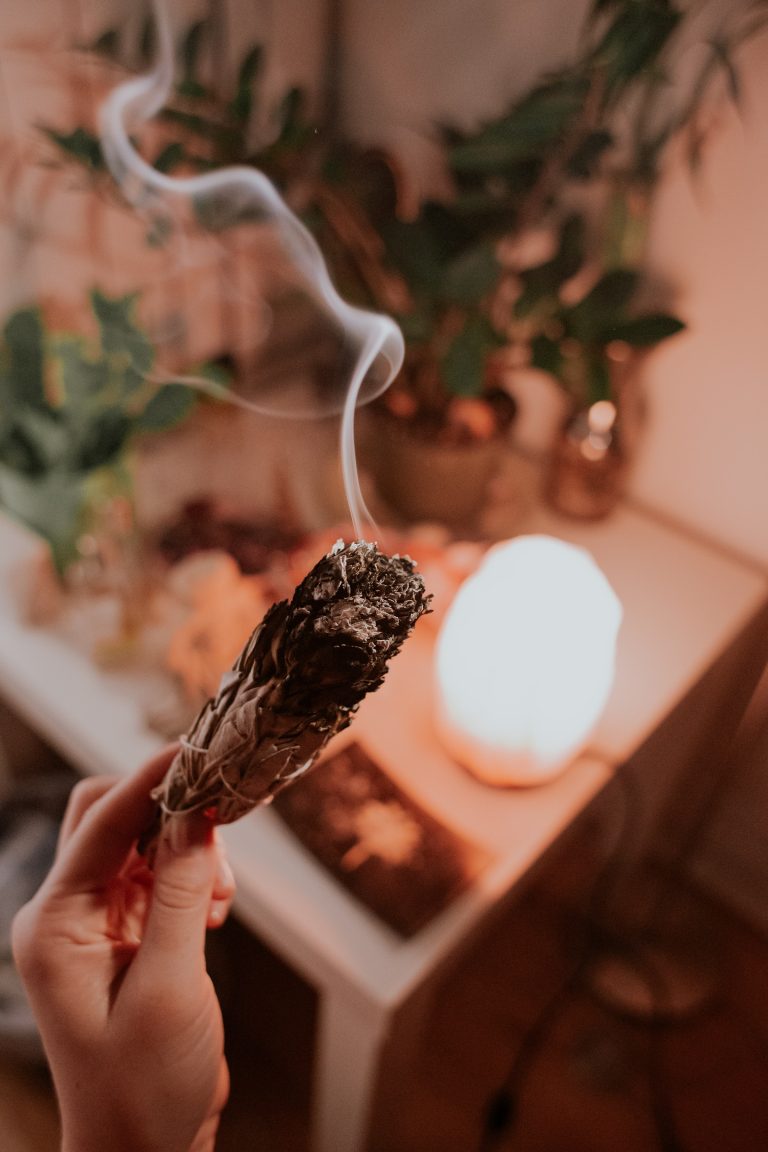
An altar is not a shelf of beautiful objects.
I want to say that clearly at the outset, because the version of altars that circulates most widely on the internet is exactly that: a carefully arranged collection of aesthetically coherent things, photographed in good light, presented as evidence of a practice. It is gorgeous, frequently. It is also, in many cases, missing the point entirely.
An altar is a physical anchor for your intention. A space you return to with awareness, that over time becomes charged with the accumulated weight of every moment of practice that has happened there. The objects on it are not decorations. They are tools, each one chosen because it means something specific to you and supports something specific in your practice. The difference between an altar and a shelf of beautiful witchcraft-adjacent objects is the same difference between a ritual and a routine: the quality of attention and intention you bring to it.
That distinction established, let us talk about how to actually build one.
What an altar is for
Before you place a single object, it is worth understanding what you are building and why, because the function of your altar should determine its form, and that function is personal rather than prescribed.
Altars serve as a focal point. When you sit in front of your altar, you are making a physical statement to your own nervous system: this is different from the rest of my life. This is set apart. This is the space in which I pay a different quality of attention. The brain responds to environmental cues more readily than most people realise, and a consistent, intentional physical space becomes, over time, a powerful trigger for the particular state of mind that practice requires.
Altars serve as a record. The objects on an altar accumulate meaning through use. The candle you burn every morning during your practice, the crystal you hold when you need grounding, the photograph of someone you love; these things become saturated with the intention and attention you have brought to them. They are not merely symbolic. They are, in a very real sense, charged.
Altars serve as a reminder. In the middle of an ordinary day, a glance at your altar is enough to reconnect you with your practice, your intention, your sense of yourself as someone who is doing this work. That small reconnection, repeated daily, is not nothing. It is part of how a practice stays alive.
What an altar does not need to be
- Permanent. Many practitioners work with altars that are set up and taken down for each working: a cloth laid out, objects arranged, and then put away again. This is particularly useful if you share your space, if privacy matters to you, or if you simply do not have a surface to dedicate to a fixed altar. A practice held in a box that you open when you need it is just as real as one displayed on a windowsill.
- Large. Some of the most powerful altars I have encountered have been very small; a corner of a bookshelf, a single candle on a bedside table, a windowsill with three objects chosen with care. Scale has nothing to do with efficacy. What matters is that the space is intentional and that you return to it with awareness.
- Expensive. The witchcraft market will happily sell you a great deal of altar equipment. Most of it is unnecessary. A candle from a supermarket, a stone picked up on a walk, a photograph, a dried flower from the garden; these things, arranged with intention and used with consistency, are a complete altar. No specialist purchases required.
- Instagrammable. I say this without judgement toward people whose altars are beautiful; beauty in a practice is real and worth having. But if the aesthetic pressure of what an altar is supposed to look like is getting in the way of building one that actually works for you, set the images aside. Build the functional version first. The beautiful version, if you want it, will follow naturally from a practice that is genuinely alive.
How to build yours, step by step
Start with a surface. Any surface will do. A windowsill, a corner of a dresser, a small tray you can move when needed, a piece of cloth laid on any flat surface. The surface itself is not precious; what happens on it is.
Choose a focal point. Most altars have one object or element that anchors everything else; the thing your eye goes to first, the thing that most directly represents the core intention of your practice. For many practitioners, this is a candle because fire is the most immediate and visceral symbol of intention we have access to. For others, it is an image: a deity, an ancestor, a symbol that holds particular meaning. For others still, it is a natural object: a stone, a piece of wood, a shell. There is no correct answer. The question is: what feels most alive to you, most connected to why you are building this in the first place?
Add what supports your intention. Working from your focal point outward, add objects that support the specific intention of your practice. If you are building an altar for protection, you might add herbs associated with protection, a colour associated with it, a symbol that means safety to you. If you are building an altar for a season or a sabbat, you might add natural objects that reflect that season: leaves, flowers, fruit, a candle in the seasonal colour. If you are building a general practice altar rather than one focused on a specific intention, you might add objects representing each of the four elements, or objects connected to the aspects of practice that matter most to you.
Include something personal. This is the step most altar guides leave out, and it is the step that makes an altar yours rather than a copy of someone else’s. One object, at minimum, should be on your altar because of its personal significance rather than its traditional correspondence. A photograph, a gift from someone you love, an object from a place that matters to you, something inherited, something found. This personal anchor is what stops an altar from being a generic collection of witchcraft objects and makes it a genuine record of who you are.
Leave space. An overcrowded altar is harder to use than a simple one. Leave enough clear space to actually work; to place a candle, to write, to hold an object during practice. The objects around the edge should support the work that happens in the centre, not fill the space so completely that there is no room for the work itself.
Tending your altar
An altar that is built and then ignored is a shelf of objects. An altar that is tended is something else entirely.
Tending does not need to be elaborate. It might mean lighting a candle each morning and sitting quietly for five minutes. It might mean refreshing the seasonal objects as the year turns. It might mean simply touching each object as you pass, bringing a moment of conscious awareness to the space. It might mean cleaning it regularly; dust is not spiritual, and a clean altar is an altar you are paying attention to.
What matters is the returning. The regular, intentional act of coming back to the space with awareness; acknowledging it, using it, letting it do the thing it is there to do. A practice that returns to the same physical space consistently, over months and years, builds something that cannot be rushed or faked: a genuine accumulation of meaning in a particular place.
That accumulation is what makes an altar more than a shelf. It is what makes it, eventually, sacred; not in a religious sense necessarily, but in the sense of set apart, charged, belonging to something larger than the ordinary run of daily life.
One place to begin
If you do not have an altar yet, here is the simplest possible starting point.
Find a surface, any surface. Place one object on it that means something to you. Light a candle beside it. Sit in front of it for three minutes and let your mind settle. That is an altar. That is the beginning.
Everything else grows from there.