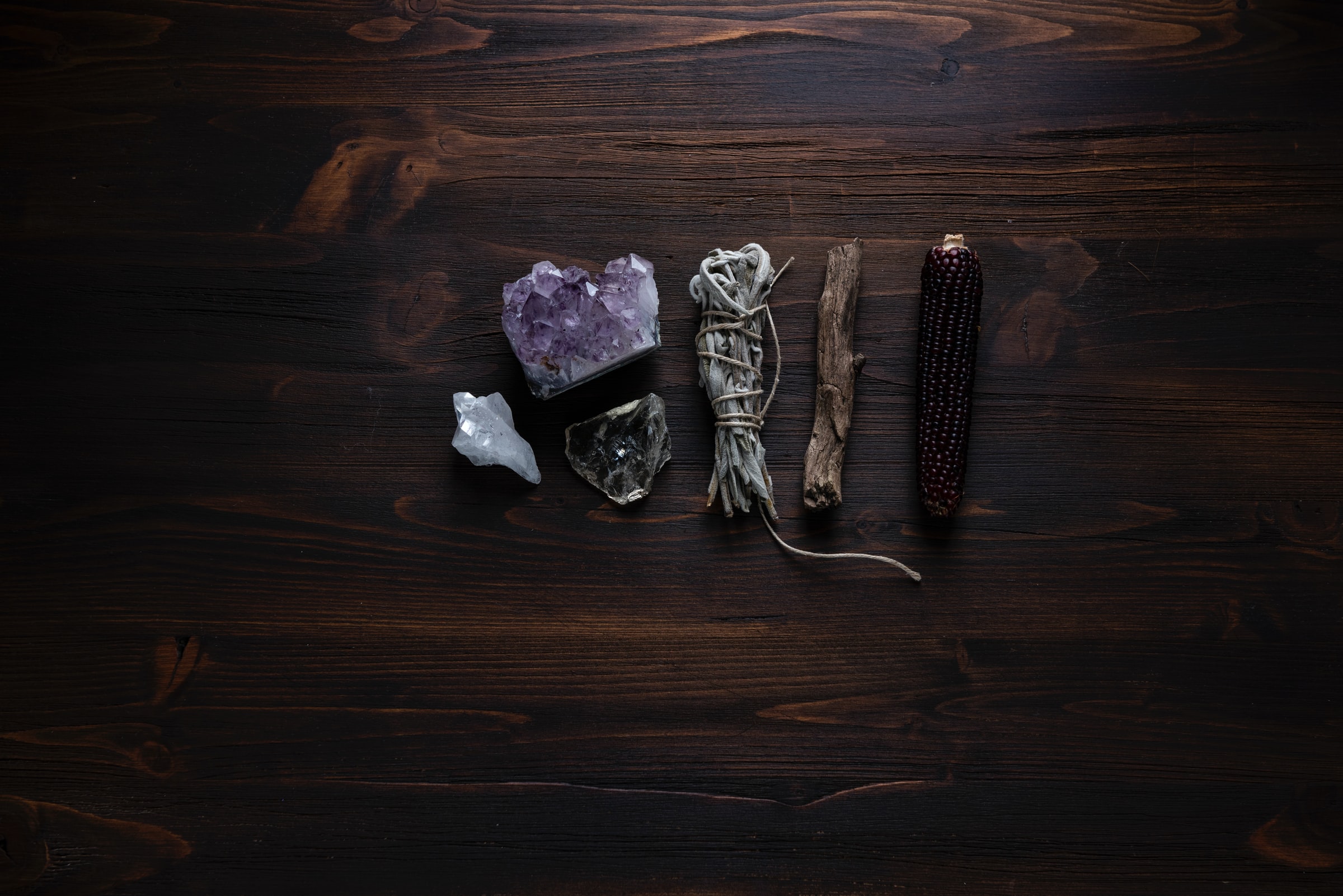
If you have spent any time in witchcraft spaces, you have encountered correspondences. Lists of them, usually. Colour correspondences. Herb correspondences. Crystal correspondences. Moon phase correspondences. Planet correspondences. Day of the week correspondences. Sometimes they are presented as simple tables. Sometimes as elaborate systems that seem to require cross-referencing three different sources before you can light a candle with any confidence.
If you have ever looked at one of these lists and felt simultaneously informed and slightly defeated, welcome. That feeling is not a sign that witchcraft is not for you. It is a sign that you have been introduced to correspondences in the least useful possible way.
Let me try a different way.
What a correspondence actually is
A correspondence is a relationship between two things that share a quality; not a physical quality, but a symbolic or energetic one. A relationship of meaning.
Lavender and calm share a quality. Not because there’s a measurable force connecting them, but because centuries of human experience (of growing lavender, tending it, smelling it, using it in medicine and in ritual) have established a relationship between that plant and that state of being. The correspondence is real in the way that all culturally accumulated meaning is real: it exists because enough people, over enough time, have found it to be true in their experience.
The same logic applies to colours, crystals, planets, moon phases, days of the week, numbers, animals, and every other category of correspondence you will encounter. Each one is a distillation of accumulated human meaning-making; a shorthand that encodes a relationship between a thing in the world and a quality of experience.
This matters because it changes how you relate to the lists. They are not rules handed down from an authority you must defer to. They are records of other people’s experiences, offered as a starting point for your own.
How correspondences work in practice
The practical purpose of correspondences is coherence.
When you bring together a collection of things that share a symbolic quality (a green candle, a sprig of rosemary, a piece of aventurine, a new moon) you are building an environment of aligned meaning. Everything in the ritual points in the same direction. And when everything points in the same direction, your intention has more to move through, more purchase on your own unconscious, more clarity of signal.
This is why correspondences are useful, and it is also why they are not strictly necessary. The thing doing the actual work is always your intention; the focused, directed, honest desire that you bring to the practice. Correspondences are the supporting cast. They create the conditions in which intention can move more freely and more powerfully. They’re not the source of the magic. You are.
Which means that a ritual with imperfect correspondences and a clear, honest intention will always outperform a ritually perfect setup built around a vague or half-hearted one. Every time.
Keep that in mind whenever you feel anxious about using the wrong colour or the wrong herb. The wrong correspondence used with full intention is more powerful than the right correspondence used without it.
The most common correspondence systems
Before we get to building your own, it is worth understanding the most widely used systems; where they come from and what they are good for.
- Colour correspondences are among the most accessible and the most immediately intuitive. White for purification and new beginnings. Black for protection and banishing. Red for passion, courage, and fire energy. Green for growth, abundance, and the natural world. Blue for calm, truth, and communication. Purple for spiritual connection and transformation. Gold and yellow for success, clarity, and solar energy. These are not arbitrary; they draw on millennia of human colour symbolism across many cultures, filtered through the Western magical tradition. They are a useful foundation, and most people find them relatively easy to internalise because they overlap significantly with the colour associations we already carry from everyday life.
- Herb and plant correspondences are among the oldest and most extensively documented in folk magical traditions. The cunning women and wise men of British and European folk history worked primarily with plants; their correspondences were accumulated through generations of practical use, oral transmission, and lived experience. Rosemary for memory and protection. Lavender for calm and purification. Mint for abundance and momentum. Rose for love in all its forms. These connections are deep-rooted in the literal sense, they have had a long time to settle.
- Lunar correspondences map qualities of intention and energy onto the eight phases of the moon cycle. New moon for beginnings and intentions. Waxing phases for building and growth. Full moon for culmination, celebration, and release. Waning phases for letting go, reflection, and rest. This system is particularly useful for timing, for deciding when to do a working rather than what to put in it.
- Elemental correspondences connect the four classical elements (earth, air, fire, and water) to directions, qualities, tools, and types of magical work. Earth for stability, grounding, and material matters. Air for thought, communication, and new beginnings. Fire for transformation, courage, and passion. Water for emotion, intuition, and healing. The elements appear in some form in most Western magical traditions and provide a useful underlying framework for understanding how different energies relate to each other.
- Planetary correspondences are the most complex of the common systems, connecting the seven classical planets (Sun, Moon, Mercury, Venus, Mars, Jupiter, Saturn) to days of the week, colours, metals, herbs, and types of magical work. They are deeply embedded in Western occult tradition but require more investment to learn and use fluently. Worth exploring once you have a foundation, but not essential at the beginning.
The problem with published lists
Here is something the published lists rarely tell you: they disagree with each other constantly.
Pick up three different witchcraft books and look up the correspondence for, say, the colour orange. You will find abundance, creativity, legal matters, joy, attraction, and at least two contradictions between sources that consider themselves authoritative. The same plant will appear under different planetary rulerships in different traditions. Crystals especially are a source of significant disagreement, the correspondence for a given stone varies considerably depending on whether you are consulting a modern crystal healing text, a Western magical tradition source, or a folk tradition reference.
This is not a problem to be solved by finding the correct source. There’s is no single correct source. The correspondence systems we have inherited are human creations, shaped by different cultures, different historical periods, different theoretical frameworks, and the lived experiences of different individual practitioners. They overlap significantly in their fundamentals and diverge significantly in their details, and that is exactly what you would expect from a body of knowledge that has been built by many different hands over a very long time.
The practical implication: when sources disagree, use the one that resonates most with your own intuition and experience. Or use neither, and build something of your own.
How to build your own correspondence system
This is the part I most want you to take seriously, because it is where a practice stops being a performance of other people’s wisdom and starts being genuinely yours.
Your personal correspondences are always the most powerful ones available to you. Not because personal meaning is more mystically valid than traditional meaning, but because the correspondence system that actually works in your practice is the one you have genuinely internalised, the one that produces a real felt response in you rather than an intellectual acknowledgement of what is supposed to be true.
Building your own starts with paying attention.
- Start with what you already know. You already have colour associations; colours that make you feel calm, energised, grounded, expansive. You already have scent associations; smells that take you somewhere specific, that produce a mood reliably and immediately. You already have place associations, sound associations, and texture associations. These are your existing correspondence systems. Write them down.
- Work with each herb or crystal directly before assigning it a meaning. Hold the object. Smell it if it has a scent. Notice what it produces in you; not what it is supposed to produce, what it actually produces. That response is your correspondence for that object. It may overlap with the traditional one. It may not. Both are true.
- Track what you actually use and what actually works. Keep a record in your grimoire of the correspondences you reach for most often and those that have produced the clearest results in your practice. Over time, this record will become a personalised reference that is worth more than any published list, because it has been tested against your specific life, your specific intention, and your specific way of working.
- Be willing to revise. A correspondence that felt true at the beginning of your practice may feel different three years in. Your personal system is allowed to evolve as you evolve. A living reference is always more useful than a fixed one.
Where to start today
If you want to begin working with correspondences practically and immediately, here is the simplest possible starting point.
Choose one colour that you associate with something you want to call into your life right now. Find something in that colour (a candle, a piece of fabric, a flower, anything) and place it somewhere you will see it daily. Every time you see it, let it remind you of your intention.
That is a correspondence working. It is also, in its bones, exactly what the most elaborate ritual in the world is doing, just with more moving parts.
Start simple. Build from there. The system you construct over years of honest attention will be the most powerful magical tool you own.