
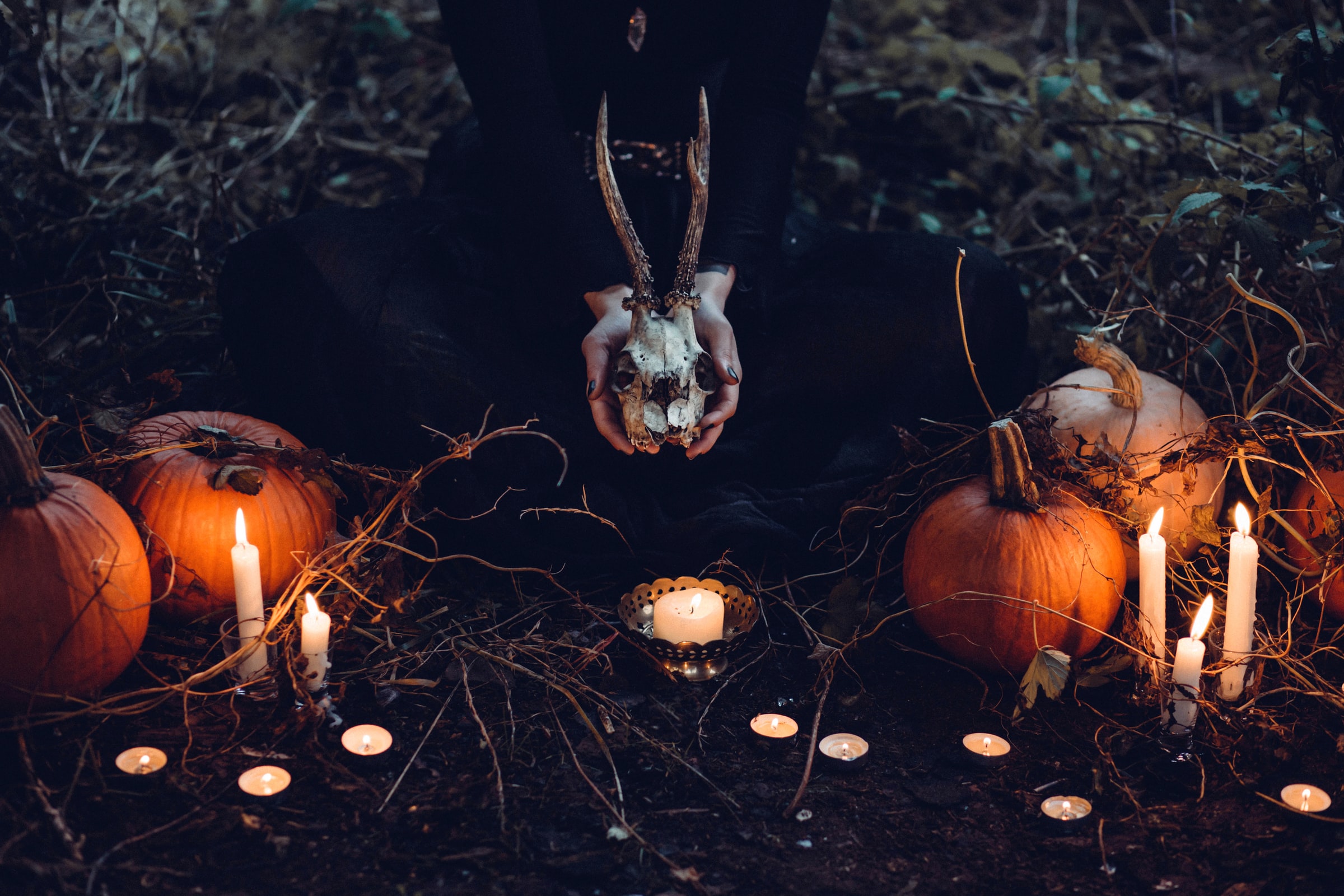

Before witchcraft had an aesthetic, it had a woman.
She lived at the edge of things, at the edge of the village, the edge of the forest, the edge of what was socially acceptable. She knew which plants to use for a fever and which to use for a broken heart. And she was called on when the baby would not come, and when the cow stopped giving milk, and when a young woman needed something she could not ask her mother for. People feared her, and they needed her, sometimes in the same breath.
She was not called a witch. She was a wise woman. The cunning woman. The herb wife. The healer. The names varied by place and century, but the figure was remarkably consistent across British and European folk tradition: a woman outside the ordinary social structure who held particular knowledge and a particular kind of power.
She is one of the most honest ancestors of modern witchcraft practices. And understanding who she actually was, rather than the version of her we have inherited through centuries of fear and romanticisation, tells us something important about what a practice grounded in reality can look like.
Who she actually was
The cunning woman of folk tradition was, in most documented cases, entirely ordinary in the sense that mattered most: she was local, practical, and embedded in the community she served. She was not separate from daily life; she was woven into it.
Historical records from Britain and Ireland describe cunning folk as people who provided a specific set of services: healing illnesses in people and animals, identifying thieves, locating lost objects, lifting curses or ill-wishes, and providing charms for protection and luck. They charged for their services. They had reputations to maintain. And they worked within a system of community trust that, if broken, could end their livelihood entirely.
The knowledge they held was a mixture of what we would now separate into distinct categories: herbal medicine, psychology, ritual, and a deep familiarity with the natural rhythms of their particular landscape. They did not make these distinctions themselves. A remedy for a sick child might involve a poultice, a spoken charm, and advice about the household’s behaviour; all three delivered as a single prescription, because the wise woman did not separate the physical from the emotional from the spiritual. Neither, she understood, could her patients.
This integration is one thing I find most striking when I read historical accounts of cunning folk. The modern tendency to compartmentalise, medicine over here, mental health over there, spirituality in its own separate box on Sunday, would have been entirely foreign to her. She treated the whole person, in the whole context of their life, using every tool available to her.
What the folklore actually says
One of the most consistent threads in the folklore of wise women across Britain and Ireland is the idea of the gift: the sense that the cunning woman’s knowledge was not simply something she learned but was innate or inherited. Seventh sons of seventh sons were said to be born healers. Wise women often came from lines of wise women. The knowledge passed through blood as much as through instruction.
This is almost certainly partly myth; the story a community tells about the people it needs to believe in. But it points to something real: the knowledge held by cunning folk was not codified, not written down in any systematic way, and not accessible through any institution. It was embodied, relational, and oral. It lived in people, not in books.
Which means it was always necessarily personal. The wise woman of one village interpreted her craft differently from the wise woman of the next. The charms she used, the plants she favoured, the way she understood illness and misfortune; all of it was shaped by her particular life, her particular landscape, her particular experience. There was no correct version. There was only the version that worked for her and for the people she served.
I find that deeply reassuring, as someone building a modern practice. The historical record doesn’t support the idea that there is one right way to do this, one correct set of correspondences, one authentic tradition, one legitimate lineage. It never was. The wise women who came before us were improvising, adapting, making it work with what they had. We are doing exactly the same thing.
What the wise woman can teach us
There are three things I come back to whenever I think about the cunning women of folk tradition, and they have quietly shaped the way I think about practice.
The first is that usefulness is the measure. People didn’t evaluate the wise woman’s practice by how elaborate it was, how aesthetically coherent, or how closely it adhered to any tradition. They evaluated it by whether it helped. That seems like the right standard.
The second is that the local matters. The wise woman knew her particular landscape: its plants, its weather, its seasons, its specific community needs. A practice rooted in the place you live, the rhythms you experience, the plants that grow near you, is always going to be more alive than one imported wholesale from somewhere else.
The third is that integration is the point. She did not separate the practical from the spiritual, the physical from the emotional, the everyday from the magical. Neither should we. The practice that changes your life is not the one reserved for full moons and elaborate rituals. It is the one woven so thoroughly into your ordinary days that eventually you cannot tell where the magic ends and the life begins.
That is what she was building in her house at the edge of the village.
That is what we are building too.
From the apothecary, with love. 🌿
— George

